
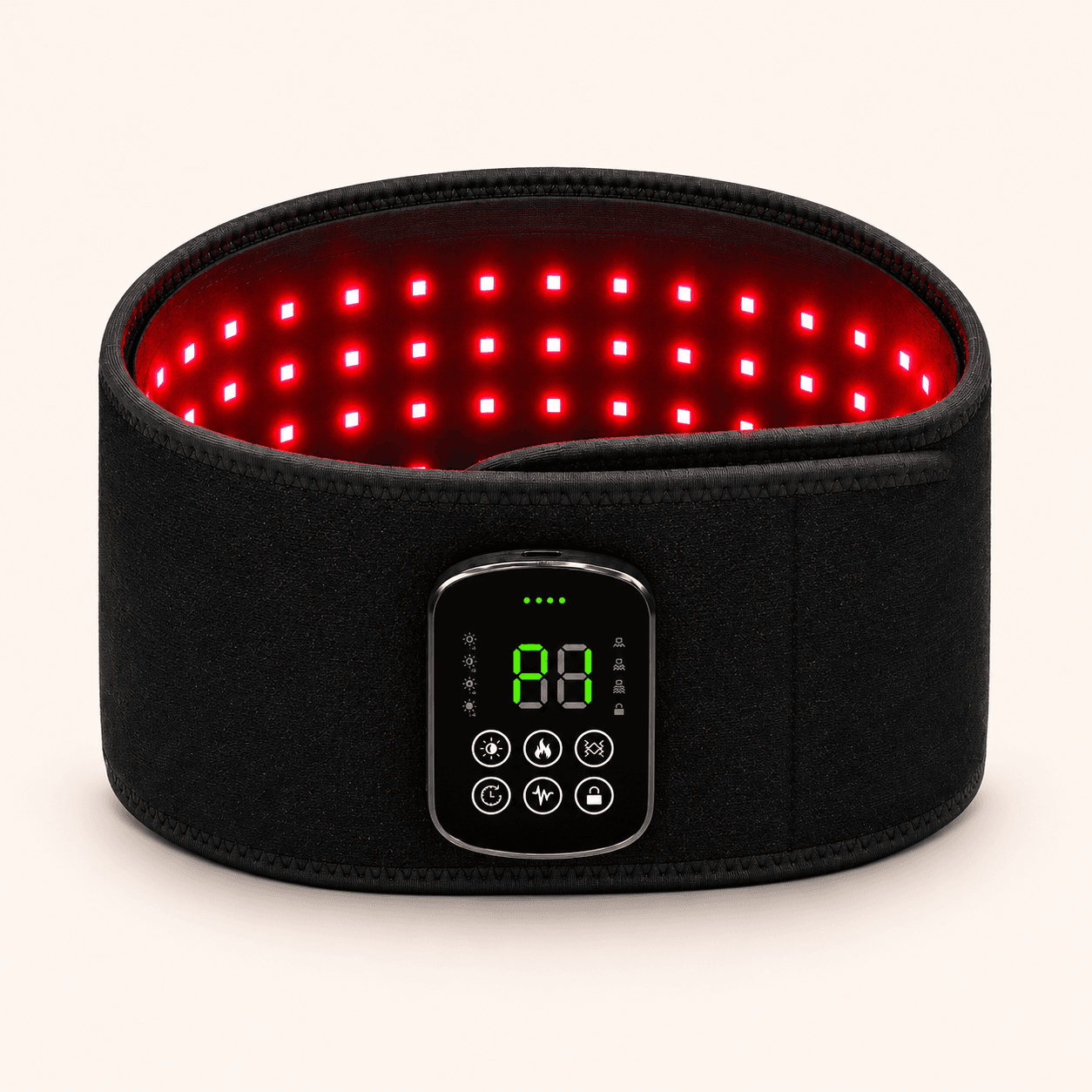
Buying Guides9 min
Red Light Therapy Pad vs. Belt vs. Wrap: Which Should You Buy?
Pad, belt or wrap? Compare how each format fits, powers and feels in daily use, using the real styles, prices and specifications of our portable wrap range.
A plain-English guide to bed wattage, 15-amp and 20-amp circuits, 240-volt needs, extension cords and running costs, with sources you can check yourself.

You found a full-body red light therapy bed you like, then spotted the line in the specifications: 6,600 W. Now you are wondering whether it can plug into the wall in your spare room, or whether you need an electrician before you even order.
The short answer is: sometimes. A bed that draws about 1,400 W or less can usually share a normal 15-amp household circuit. A bed in the 1,500 to 2,400 W range needs a 20-amp circuit. A bed rated in the thousands of watts needs a dedicated higher-current circuit, which usually has to be installed. The number that decides it is the power rating on the bed's label, not how big the bed looks.
This guide uses published electrical standards, manufacturer specification pages, U.S. government electricity-price data and PubMed-indexed clinical studies instead of marketing claims, so you can check every number yourself. The sources are listed at the end. It is general information, not electrical or medical advice, so have a licensed electrician look at your home before you install anything.
Every electrical product has a power rating in watts (W), usually printed on a label or nameplate and repeated in the manual. The wall outlet is only one part of the picture. It is connected to a circuit, and the circuit breaker in your panel limits how much current that whole circuit can carry at once.
In the United States, household outlets run at 120 volts. A 15-amp circuit can supply up to 1,800 W (15 A × 120 V) and a 20-amp circuit up to 2,400 W. For loads that run three hours or longer, the National Electrical Code (NEC) limits the connected load to 80% of the circuit rating, which works out to 1,440 W on a 15-amp circuit and 1,920 W on a 20-amp circuit. A bed session is much shorter than three hours, so it is not a continuous load under that definition, but 80% is still a sensible planning margin because cords, plugs and outlets warm up under heavy draw.
That gives you a rule of thumb for a 120-volt bed:
Divide the bed's rated watts by the voltage to get the current it asks for in amps (amps = watts ÷ volts), then compare that number with the circuit's breaker rating.
Voltage and socket ratings differ by country, so the same bed can behave very differently depending on where you live. Plug shape tells you nothing about voltage: a plug adapter changes the shape of the connector, not the electricity behind it.
Full-body beds and panels vary enormously, and the numbers in marketing copy are not always the numbers measured at the wall. Here are three examples from public pages, checked in November 2026:
Take the 6,600 W rating on the supplier listing as an example. If that figure is the true full-load draw, the arithmetic is unforgiving:
It is tempting to assume that a higher wattage means a stronger treatment. Clinical researchers do not describe light therapy that way. Studies report irradiance (the light power reaching each square centimetre of skin, in mW/cm²) and dose, also called fluence (energy per square centimetre, in J/cm²). Dose equals irradiance multiplied by time: J/cm² = mW/cm² × seconds ÷ 1,000.
A 2018 review of photobiomodulation parameters (Zein, Selting and Hamblin, Journal of Biomedical Optics) notes that some groups recommend a power density below 100 mW/cm² and 4 to 10 J/cm² at the target tissue, while others recommend as much as 50 J/cm² at the tissue surface, and that the lack of agreement on parameters has in some cases led to contradictory results. The review also found that ineffective studies in cells and tissues rich in mitochondria, such as muscle and brain, were more often explained by over-dosing than by under-dosing. An earlier review (Huang and colleagues, Dose-Response, 2009) describes a biphasic dose response, in which lower levels of light often work better than higher ones.
As a simple illustration, at 20 mW/cm² a dose of 4 J/cm² takes 200 seconds and 10 J/cm² takes 500 seconds, while the same irradiance for 20 minutes would deliver 24 J/cm², well beyond that range. The point is not to chase a target number at home. It is to see why longer or stronger is not automatically better.
In practice, the electrical rating tells you what the outlet must supply, not how much light reaches you. Not all electrical power leaves the device as light: drivers, fans and controls use some, and LEDs also give off heat. Ask sellers for the irradiance in mW/cm² at a stated distance as well as the wall power.
Related guideOptical Power vs. Density: The True Measure of Light Therapy Efficacy
If you are paying for a bed and wiring a room for it, it is fair to ask what the research shows. These are the studies behind the numbers above, all indexed on PubMed:
For a high-draw device, plug straight into a wall outlet. Extension cords are meant for temporary use, should never be daisy-chained, and must carry an amp rating that matches or exceeds what the appliance draws. A thinner cord (higher gauge number) carries less current than a thicker one (lower gauge number), and an overloaded cord can overheat and become a fire hazard. A power strip has its own rating, so do not assume it can handle a bed.
Electricity cost depends on watts, session length and your local rate. According to the U.S. Energy Information Administration, the average U.S. residential price was 18.16 cents per kWh in August 2026 (18.19 cents year to date), although rates vary a lot by state. Using 18.2 cents and a 20-minute session three times a week (about 13 sessions a month), this is the upper-bound cost if a device drew its full rated power the whole time:
If you rent, you generally cannot add a circuit yourself, and your landlord may not allow it. You still have options:
Related guideBest Red Light Therapy Devices for Home Use: How to Choose the Right Format
Before you order any bed, get these answers from the seller in writing:
So, can a red light therapy bed use a regular outlet? A smaller bed rated at roughly 1,400 W or less usually can. A bed between about 1,500 and 2,400 W needs a 20-amp circuit. A bed rated in the thousands of watts needs a dedicated higher-current circuit, which for a 6,600 W bed means 240 volts and a breaker larger than 30 A. The label, not the size of the bed, decides.
Do the math with the nameplate, ask the seller for the amps, and let a licensed electrician confirm your wiring before you buy. If you are considering the full-body bed on this site, we confirm the configuration and its electrical requirements with you before the order is finalized.
It depends on the bed's rated power. In the United States a 15-amp circuit supplies up to 1,800 W and a 20-amp circuit up to 2,400 W, with about 1,440 W and 1,920 W as comfortable planning limits. Beds rated below roughly 1,400 W usually fit a regular circuit, beds in the 1,500 to 2,400 W range need a 20-amp circuit, and beds rated above 2,400 W cannot run on a 120-volt household circuit at all. Check the nameplate rating first.
Look for the rating label on the bed, the manual or the specification sheet, and find the input power in watts (W) or amps (A) at your voltage. If only amps are listed, multiply by your voltage to get watts. Do not rely on headline figures such as lamp power or total power, which can differ greatly from what the bed draws from the wall. Once you own it, a plug-in watt meter shows the real draw.
At 120 V, a 15-amp circuit supplies up to 1,800 W (15 A × 120 V) and a 20-amp circuit up to 2,400 W. For loads that run three hours or longer, the NEC limits the connected load to 80% of the circuit rating, which is 1,440 W and 1,920 W. Everything on the same circuit counts toward the total, including lights and other outlets on the same breaker.
The NEC defines a continuous load as one that runs for three hours or longer, so a 20-minute session is not a continuous load by definition. Many people still treat 80% as a safe planning margin because plugs, cords and outlets warm up under heavy draw. A licensed electrician can tell you what applies under your local code.
It can. A breaker reacts to the combined current of everything on the circuit, so a bed plus a space heater, vacuum or hair dryer can trip it even if the bed alone would be fine. Plug the bed into a circuit with nothing else running. If you are unsure which outlets share a breaker, ask an electrician to trace the circuits.
If the rated power is above 2,400 W, yes, because a 120-volt household circuit cannot supply it. Some larger beds are specified for 220 to 240 V. The common home example is the 30-amp, 240-volt electric dryer circuit with a NEMA 14-30 outlet, which can supply up to 7,200 W on paper, or about 5,760 W at the 80% planning margin. A bed rated at 6,600 W would need an even larger dedicated circuit installed by a licensed electrician.
Avoid it. Extension cords are for temporary use, should never be daisy-chained, and must have an amp rating that matches or exceeds what the appliance draws. A thin or overloaded cord can overheat and become a fire hazard, and a power strip has its own limit. If you cannot avoid a cord, use a short, heavy-gauge one with a printed amp rating above the bed's draw.
A plug adapter only changes the shape of the connector, not the voltage. A voltage converter or transformer can change voltage, but it must be rated for the bed's full wattage with headroom, and at several thousand watts that means large, expensive equipment. It is usually better to choose a bed built for your local voltage, or one that supports a 100 to 240 V input. Confirm this in the specifications before buying.
They tell you the shape of the plug supplied with the bed so it fits your wall sockets. They do not guarantee that your socket can supply enough power. A UK 13 A plug tops out near 3,000 W at 230 V, a continental Schuko plug at about 3,680 W, an Australian 10 A plug near 2,300 W, and a US 15-amp outlet at 1,800 W, so a 6,600 W bed exceeds all of them. Ask the seller which voltage the bed is built for and what circuit it needs.
Not necessarily. Some listings quote lamp power, LED power or total power figures that are not the electrical input. One public retail listing for a full-body panel shows 2,400 W of lamp power next to an 800 W real-power draw. Ask for the input power on the nameplate and, ideally, a measured wall reading.
Not automatically. Studies describe results in terms of irradiance at the skin (mW/cm²) and dose (J/cm²), which depend on the LEDs, the distance and the session time, not just the wall wattage. A review in the Journal of Biomedical Optics noted that ineffective studies in muscle and brain tissue were more often explained by over-dosing than under-dosing, and earlier work describes a biphasic dose response in which lower light levels often outperform higher ones. Higher wattage often means a bigger device and a bigger electrical requirement, not necessarily better results.
Using the U.S. average residential price of about 18.2 cents per kWh (EIA, August 2026) and a 20-minute session three times a week, a device drawing its full rated power costs roughly $0.63 a month at 800 W, $1.66 at 2,100 W and $5.21 at 6,600 W. Real draw is often lower than the rating, and your local rate may differ, so check your utility bill.
Ask your landlord whether a licensed electrician can add a dedicated circuit and who pays for it. If that is not possible, choose a model whose rated power fits the circuit you already have, such as a lower-wattage panel, wrap or mask, and plug it directly into an outlet with nothing else running on that circuit. Get the rated watts and amps from the seller in writing before you order.
Yes, whenever the bed needs a new circuit, a 20-amp or 240-volt outlet, or you are unsure what your wiring can carry. Bring the bed's nameplate rating, voltage range and plug type, and ask: can my panel take the extra load, what breaker size, wire gauge and receptacle do you recommend, do I need a permit, and where should the outlet go relative to the bed? Do not modify wiring yourself unless you are qualified and permitted to do so.
The evidence is limited and mixed. A small crossover study of 12 trained men found no significant difference in muscle-damage and inflammation markers after whole-body light-bed therapy, while a triple-blinded, placebo-controlled trial of 42 people with fibromyalgia reported significantly lower pain and better quality of life after 12 sessions over four weeks. A meta-analysis of smaller light devices reported modest gains in muscle performance when used before exercise. Results depend on the device and protocol, none of this proves what a specific bed will do for you, and it is not medical advice.
Checked in November 2026. Product specifications and electricity prices change, so confirm current figures before you buy.
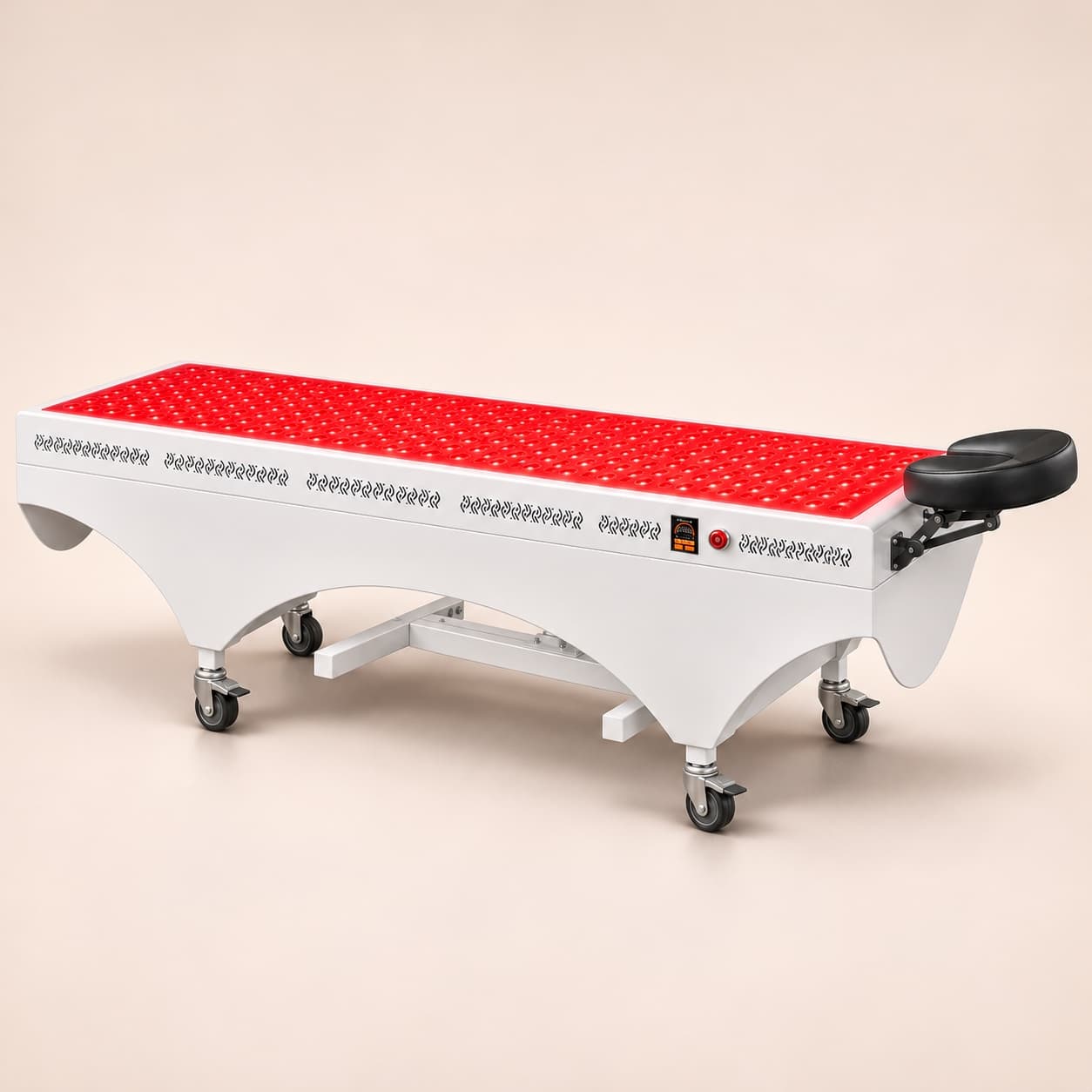
Full-body light therapy bed with 10 listed wavelengths and touchscreen control
Pad, belt or wrap? Compare how each format fits, powers and feels in daily use, using the real styles, prices and specifications of our portable wrap range.
A practical, consumer-friendly guide to choosing between wraps, wearable devices, chest-area formats, panels, and full-body systems without getting distracted by hype.
Your cart is empty.